
Morocco: Fes, the Sahara, and Why We Hired a Single Local Guide
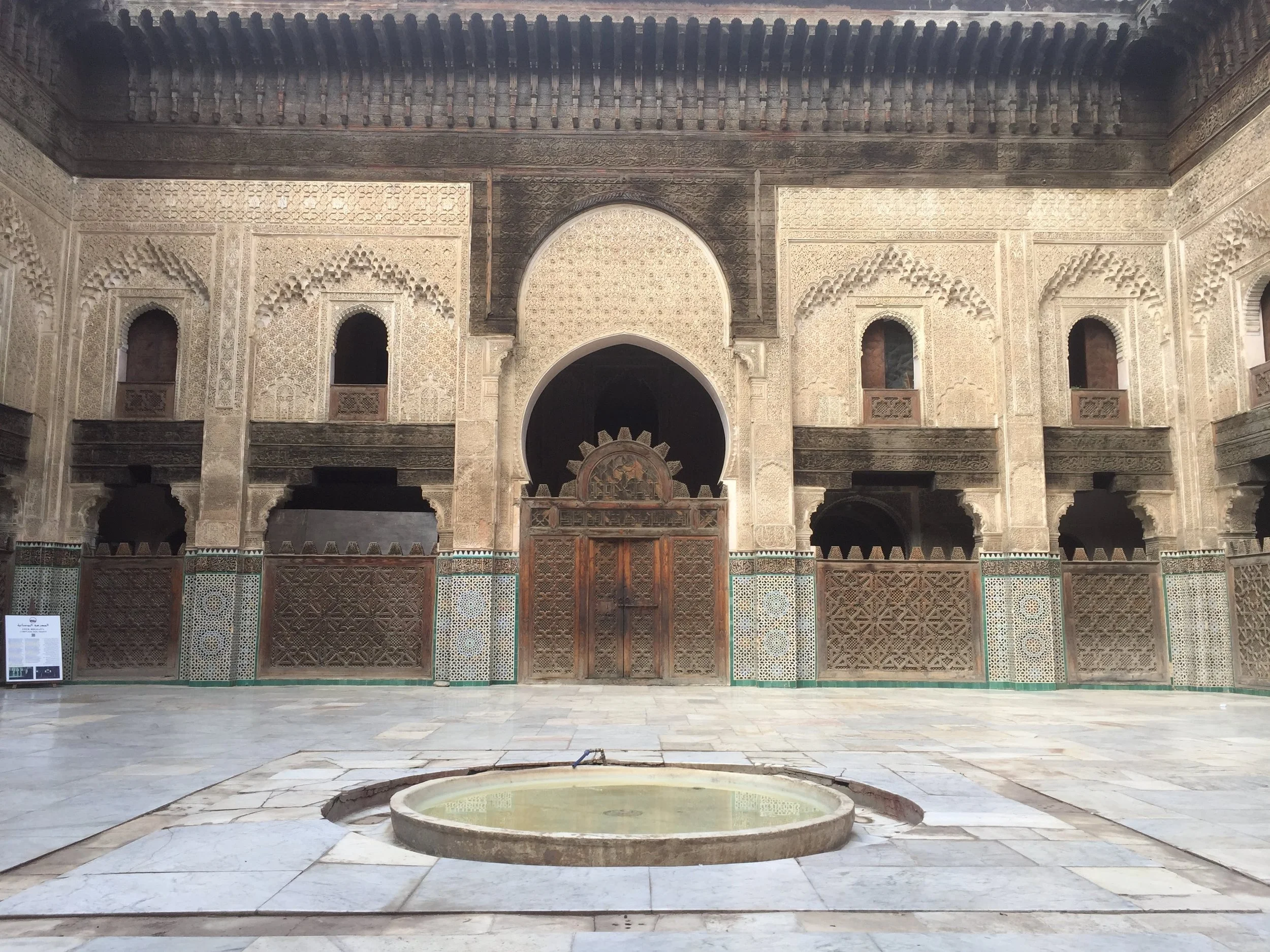
The University of Al Quaraouiyine
Morocco is one of those countries where how you go matters more than where you go. The same itinerary — Fes, the Middle Atlas, the Sahara — can be a packaged bus tour where you see the country through a tinted window, or it can be a road trip with one person from the region, in his own car, stopping where he wants to stop. We did it the second way. It was one of the best decisions we've ever made on the road.
We started in Fes, stayed in a beautiful riad in the medina for several nights, then drove south with a single local guide — through his own hometown in the Middle Atlas, past Barbary macaques in the cedar forests, down through the Ziz Valley, to Merzouga on the edge of the Sahara, where we spent two nights with Berber hosts and camels under the dunes.
Here's the trip.
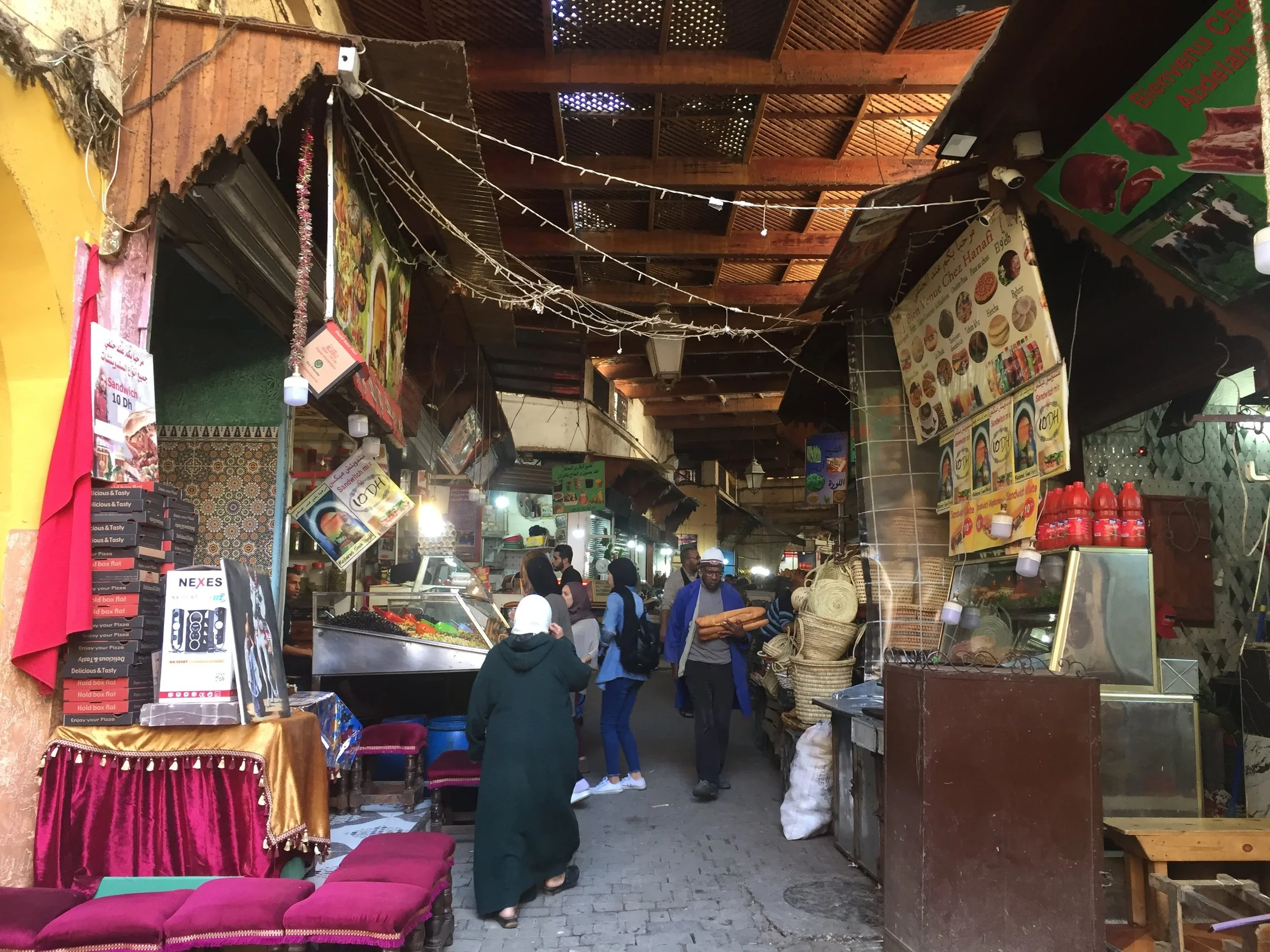
Fes Medina
Part 1 — Fes
Staying in a Riad
A riad is a traditional Moroccan house built around an interior courtyard — usually with a central fountain, carved cedar, hand-painted zellige tile, and a rooftop terrace with a view of the medina. From the street, a riad is just a plain wooden door in an unmarked alley. You knock, someone opens, and you step inside into a small palace.
Staying in a riad is one of the best conscious-travel choices you can make in Morocco. Most are small, family-run, often restored by the people who own them. The money goes directly to Moroccans. The experience is intimate — you'll have mint tea with the owner, they'll explain the medina, they'll tell you which restaurants are good and which ones are for tourists. A big international hotel outside the medina can't come close.
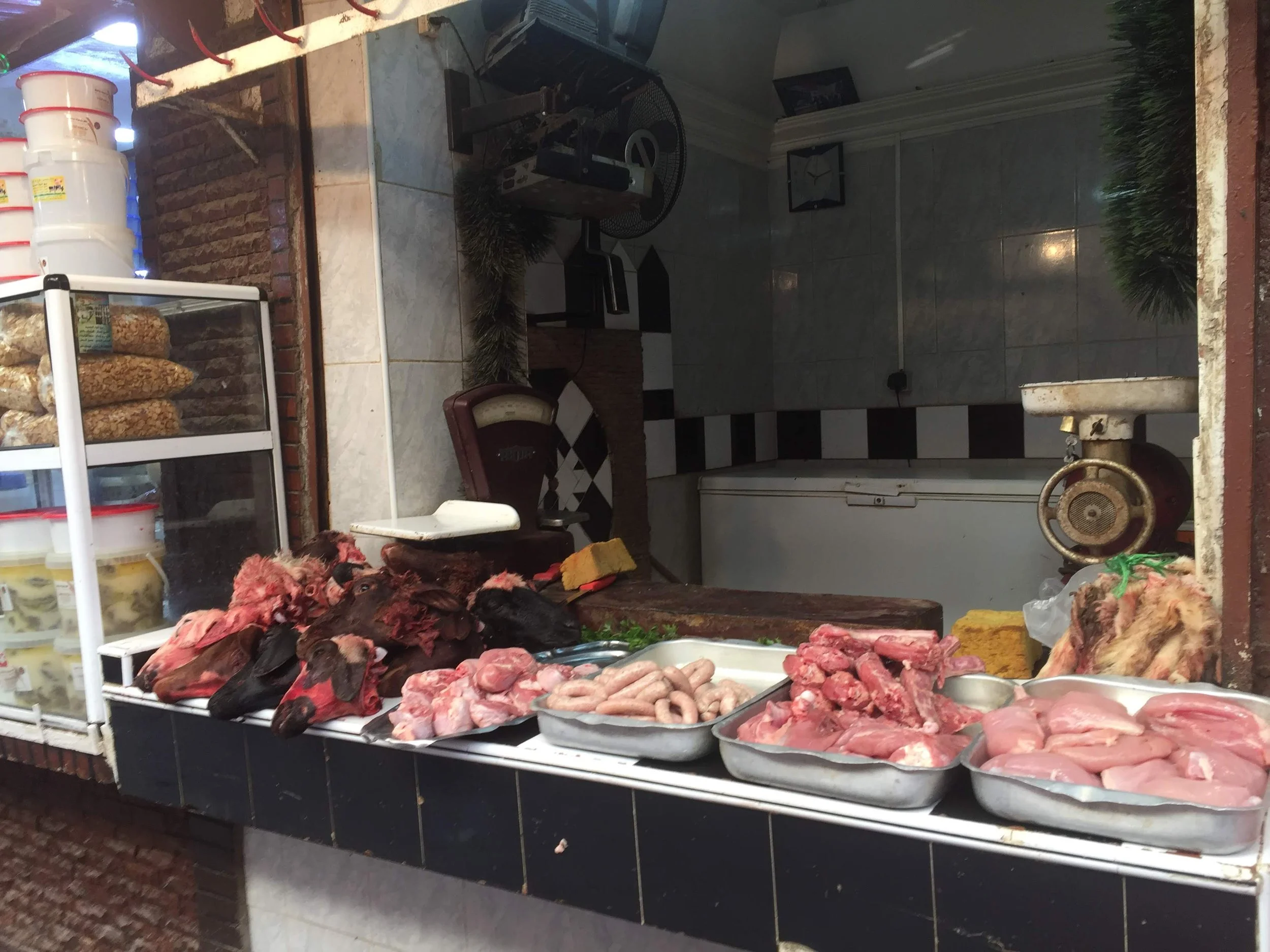
Meat market in the medina
Fes el Bali — The Medina
Fes el Bali is a UNESCO World Heritage Site and the largest car-free urban area on earth — roughly 9,000 streets packed into a walled medieval city founded in the 9th century. You enter through Bab Bou Jeloud, the famous blue gate (rebuilt in 1913, but based on much older foundations), and within three minutes of walking inside, you have no idea where you are. Donkeys carry goods because the alleys are too narrow for vehicles. Cats sleep on every doorstep. The call to prayer reaches you from five directions at once.
Things worth slowing down for inside the medina:
Bou Inania Madrasa, built in the 1350s by the Marinid sultan Abu Inan, is one of the finest examples of Marinid architecture anywhere — carved cedar, zellige tile, stucco fretwork, and a courtyard so serene it feels like the medina outside is a different country. Small entrance fee, absolutely worth it.
Chouara Tannery, the 11th-century tanning pits where workers still treat and dye leather using methods that haven't changed in a thousand years. You view it from a leather shop's rooftop terrace (the shopkeeper hands you a sprig of mint to hold under your nose — the smell is… something). No entrance fee, but buy something from the shop you view it from. That's the deal, and it's a fair one.
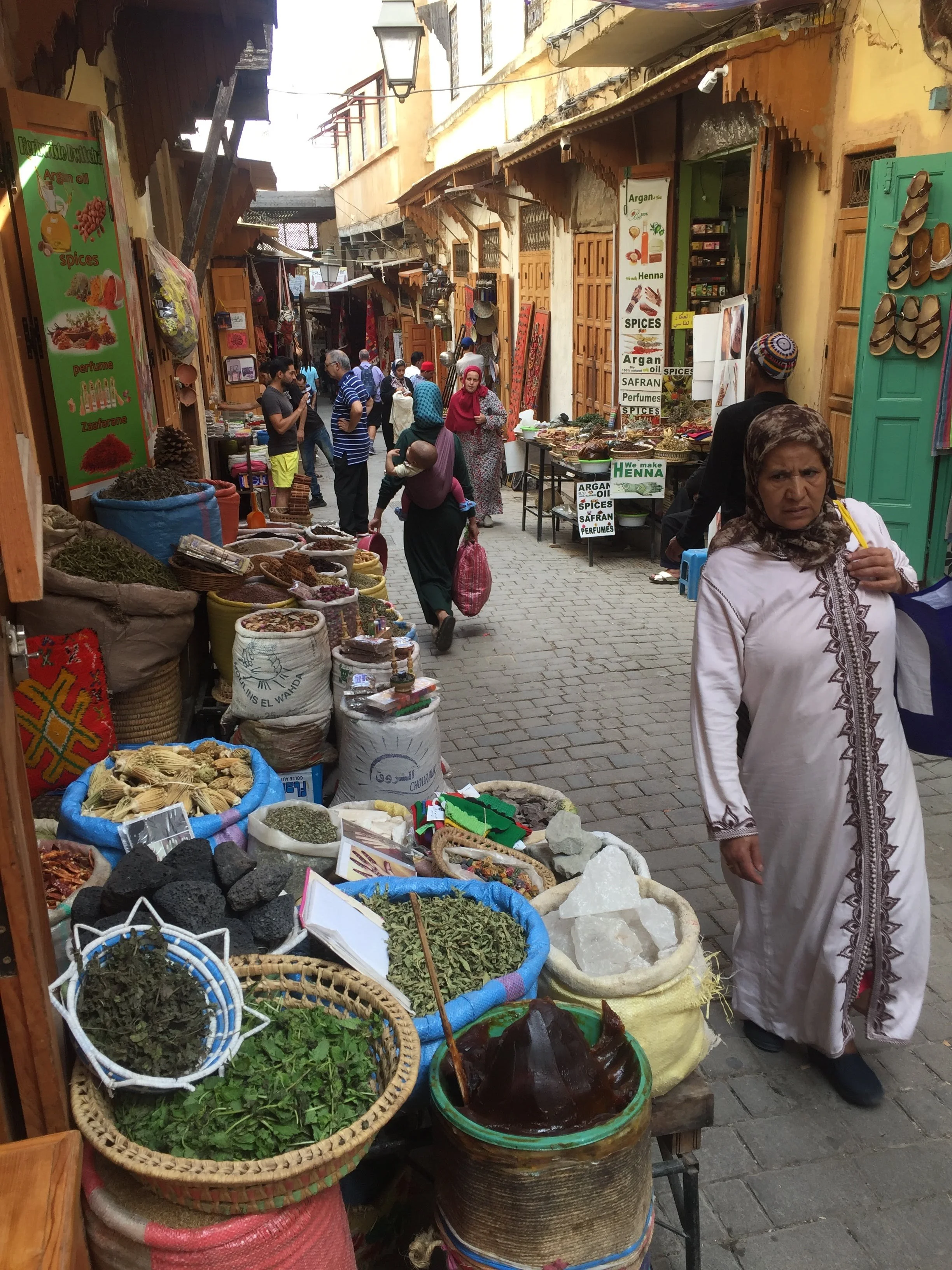
Spices shop in the medina
The University of Al-Qarawiyyin
We want to give this one its own section, because of all the places we visited in Morocco, this is the one we're still thinking about.
The University of Al-Qarawiyyin is the oldest continuously operating educational institution in the world. It was founded in 859 AD — more than four centuries before Oxford, nearly two centuries before Bologna — and it has been teaching, without a single interruption, ever since. UNESCO recognizes it. Guinness recognizes it. It's still functioning today as a center of Islamic learning, with actual students attending actual classes in a building that has held classes for twelve hundred years.
And here is the part that, for us, made standing there feel like something: it was founded by a woman. Her name was Fatima al-Fihri. She was born in what is now Tunisia, emigrated with her family to Fes in the 9th century, and when her father died and left her a substantial inheritance, she used the money to build a mosque and a school for her community. She is said to have fasted daily throughout the years of its construction until the work was complete. The school she founded became the university, and the university became the one every other university in the world is measured against in terms of age.
In a year when it can feel like history has been written to erase women from their own contributions, standing in front of a building founded by a woman in the 9th century — a building that has outlived every empire that came after her — is a quiet kind of powerful. We're two women traveling together. We stood there for a long time.
Non-Muslims cannot enter the mosque or the main prayer hall, but you can see the inner courtyard from the doorway and visit the associated library (recently restored, and also founded by a woman — al-Qarawiyyin's library is the oldest working library in the world, and its most recent restoration was overseen by the Moroccan-Canadian architect Aziza Chaouni). Stand at the door. Look in. Think about what has happened in that courtyard for twelve hundred years.
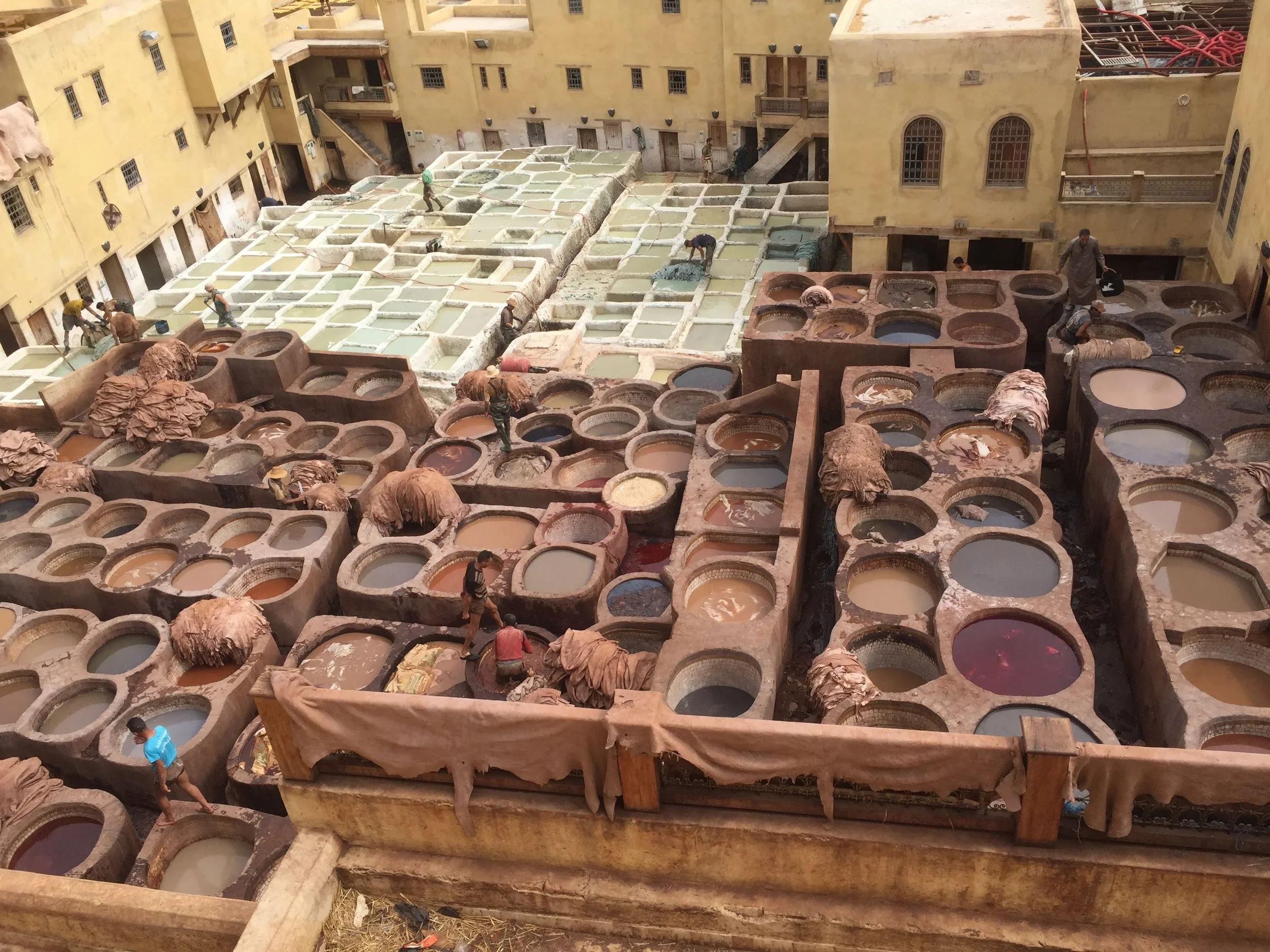
Souk’s leather coloring tanks
The Souks
The Fes souks aren't one market — they're a city's worth of specialized districts. The coppersmiths work in Seffarine Square, banging hammers on metal from sunrise. The spice sellers cluster along one alley, the dyers along another, the ceramics near Bab Ftouh, the Berber rugs in the weaving quarter, and the leather — the thing Fes is most famous for in the world — concentrated around Chouara and Ain Azliten, the old tanneries we mentioned earlier. You buy things here direct from the people who make them. There's no middleman, no gift shop, no markup for export. A copper teapot from the man who hammered it. A hand-painted ceramic plate with Arabic calligraphy from the artisan with ink on his fingers. A Berber rug from a family whose grandmother wove it in the Atlas.
A word on the leather, because Fes leather is the reason half the world's good leather goods trace back to this one city. Everything you see hanging in the shops around the tanneries — the bags, the jackets, the ottomans (poufs), the slippers (babouches), the belts, the cushions, the camel-hide lamps — was colored in the vats you just watched men working in. The quality is real. The smell, once the leather has finished drying, is the warm organic smell of actual animal hide, not factory chemicals. Colors come from the same plants that colored them in the 11th century: indigo, saffron, henna, poppy, mint. The leather shops are also where you pay for the privilege of viewing the tannery from the rooftop, which is the deal we mentioned — no cash changes hands for the view itself, but the expectation is that you'll browse downstairs afterward, and if you find something you love, you'll buy it.
Our buying notes for leather in Fes:
Buy at the tannery shops, not the souvenir stalls elsewhere. The tannery-adjacent shops are sourcing directly from the men you can see working. The leather shops near the tourist gates are often re-selling at markups.
Touch and smell before you buy. Good leather is supple, feels alive in the hand, and smells like leather. Stiff or plasticky-feeling leather is often not what you think it is.
Colors. The saturated reds, yellows, and blues from the natural dye pits are genuinely beautiful and uniquely Fassi — you won't find this range anywhere else. The softer tans and browns are more versatile, but if you want something that tells the story of the place, go for one of the dye-pit colors.
Poufs are the classic take-home. Unstuffed, they fold flat and pack easily into a suitcase. Stuff them at home with old clothes or blankets. They last forever.
Haggle. See below — this applies to leather more than anything else, because leather shops expect it, build it into their opening prices, and frankly will lose respect for you if you pay the first number.
A haggling note: bargaining isn't optional, it's the culture. Start at roughly one-third of the asking price and meet somewhere in the middle. It's not aggressive — it's a conversation, often over mint tea. Laugh. Walk away if you need to. Come back. It's how things are done. And once the price is agreed, it's agreed — don't renegotiate at the till. That's a breach of the unwritten rules.
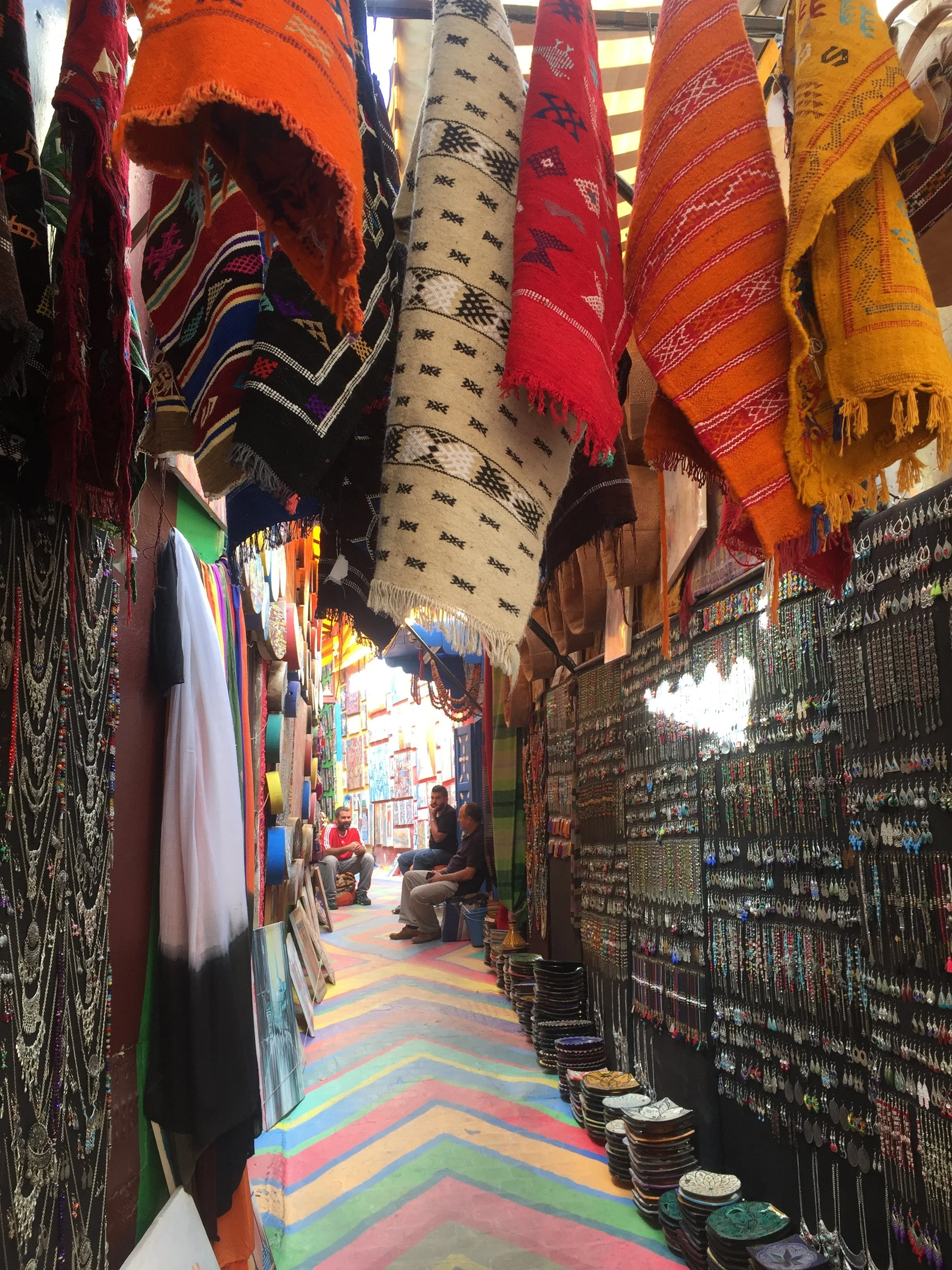
The Souks
Eating in Fes
Fes is the food capital of Morocco. The city is famous for rich, slow, aromatic dishes — tagine (the iconic slow-cooked stew in a conical clay pot), pastilla (a sweet-savory pigeon or chicken pie dusted with cinnamon and sugar, a Fassi specialty), harira (a chickpea and lentil soup traditionally eaten to break fast during Ramadan), couscous on Fridays, fresh khobz bread from neighborhood ovens, and mint tea with so much sugar it'll change your body chemistry. Eat where your riad host recommends. Eat where there are Moroccans eating. Avoid the tourist-trap places right off the main square.
Fes is a city people live in. The butchers, the bakeries, the schools, the hammams — the medina isn't a museum. Respect it. Dress modestly (shoulders and knees covered, more so around mosques). Ask before photographing people. Return smiles. Learn shukran ("thank you") and salam ("peace"). The warmth you get back is real.
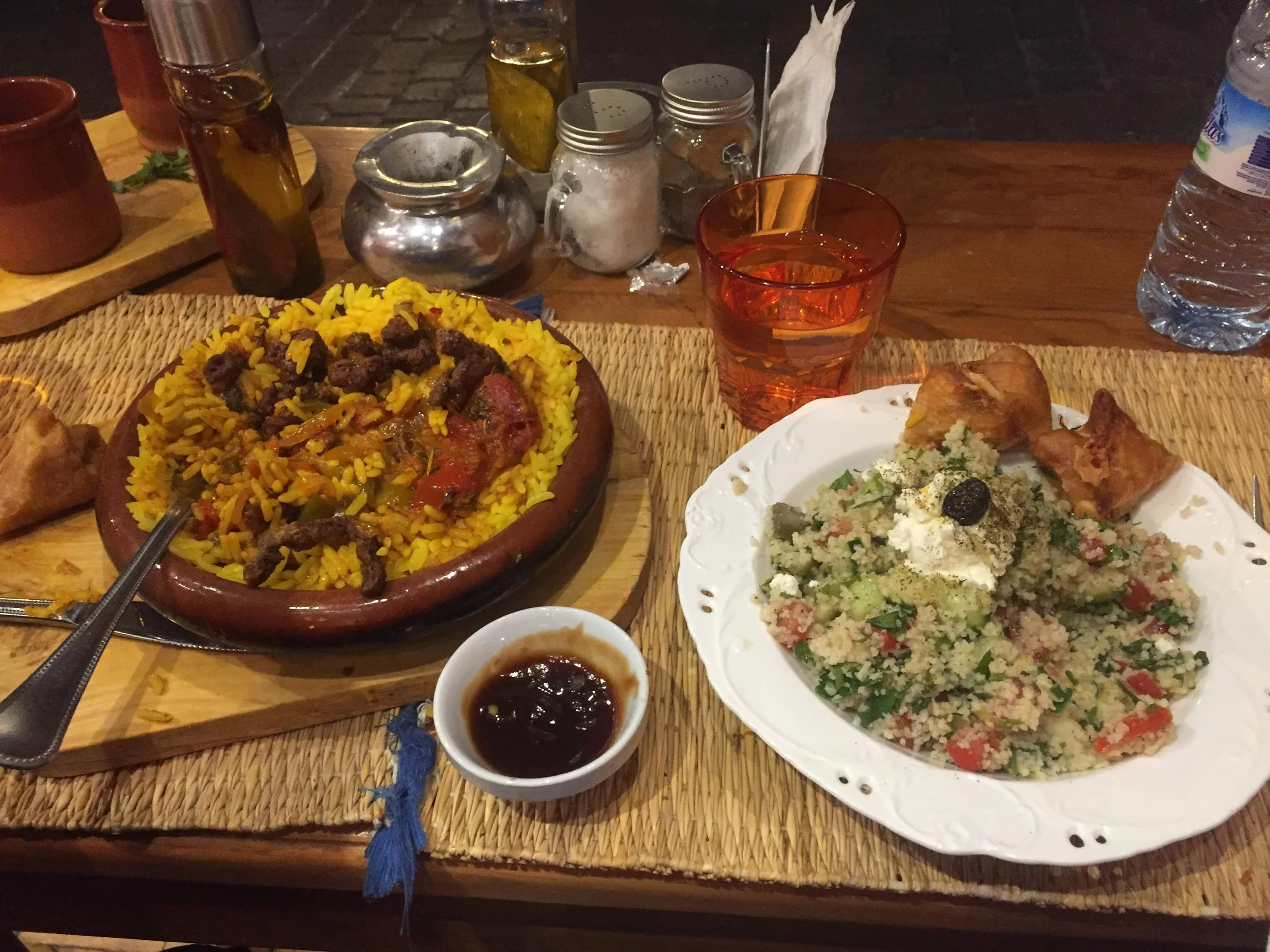
Traditional tagine
Part 2 — The Drive South, With a Local Guide
After three nights in Fes we headed south for the Sahara. The standard way to do this is a packaged bus tour — 15 strangers in a minivan, pre-set stops, souvenir-shop kickbacks, mediocre food at a fixed price. We didn't want that. We wanted Morocco, not a Morocco tour.
So we hired a single local guide — one man, his own car, two days on the road with us. He was from a small village in the Middle Atlas, and he turned the drive itself into the trip. He took us through his hometown. He stopped at a date palm along the road, climbed up, picked a handful of fresh dates off the tree, and handed them to us. He knew where the monkeys were.
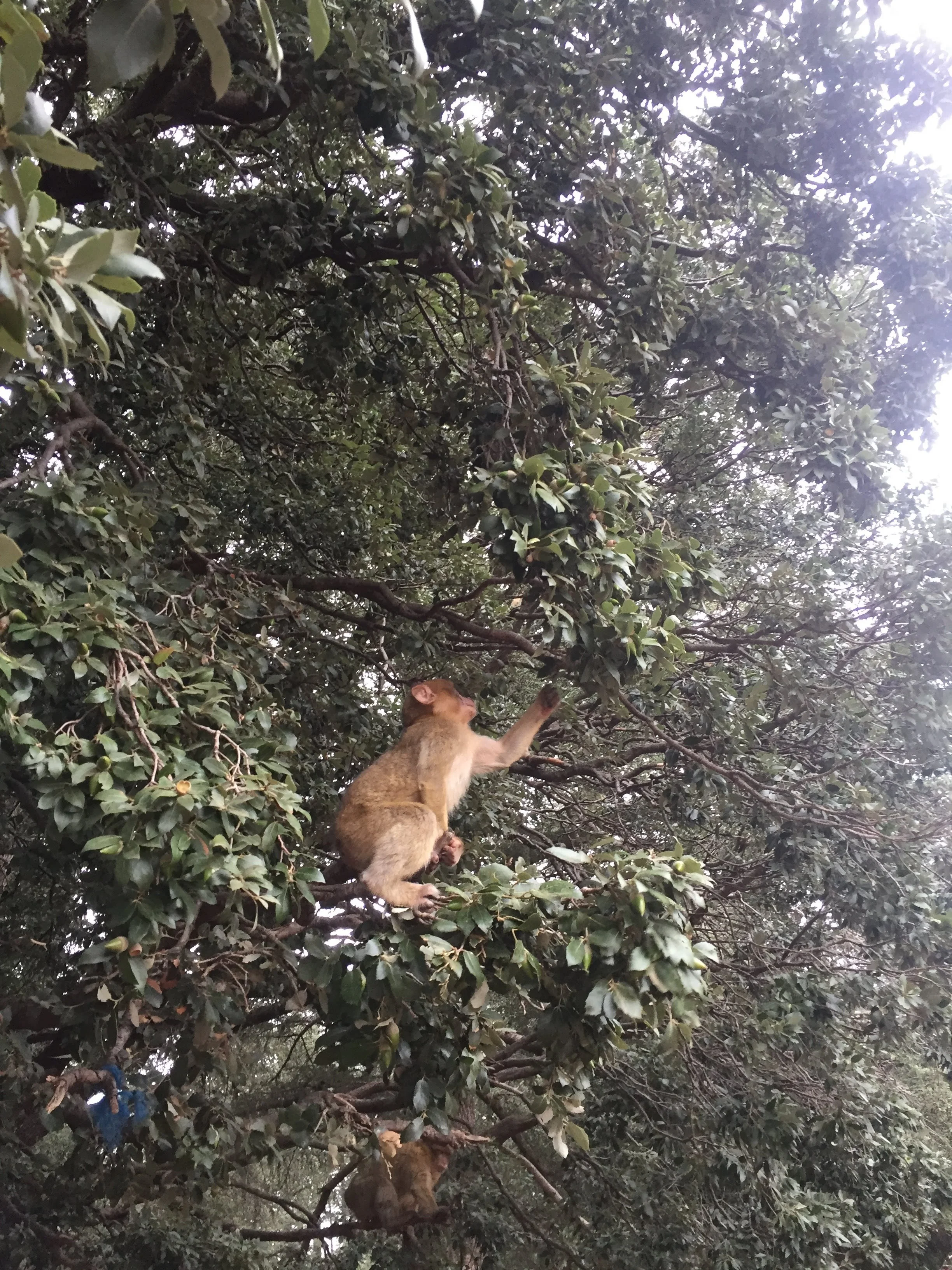
Monkeys on the side of the road
Around Ifrane and Azrou, the Middle Atlas mountains rise into cedar forests — cooler than the plains, green, strange in how un-North-African they feel. The cedars here are home to the Barbary macaque, one of the only monkey species native to North Africa, and a population under real conservation threat (habitat loss, the illegal pet trade). Our guide pulled off the road at a place he knew, and we sat for twenty minutes watching a small troop feed in the branches. No entrance fee, no crowds, no one trying to sell us anything. Just the forest and the monkeys.
A note on the monkeys: don't feed them. Tourists feeding Barbary macaques has been a real driver of the population's disruption — it encourages them to approach roads, it makes them dependent on processed human food, and it shortens their lifespan. Watch from a distance. That's the conscious version.
From the cedar forests we dropped south through the Ziz Valley and the edge of the Sahara's feeder landscapes — red-earth villages, date palms in dry riverbeds, mountains in the distance, the road emptier and emptier. The guide stopped when we wanted to stop. He told us about his family, his village, how the water gets managed, which crops grow in which month, what his mother makes for dinner on Eid. You do not get any of this on a group tour. You get it from one person whose life is in that landscape.
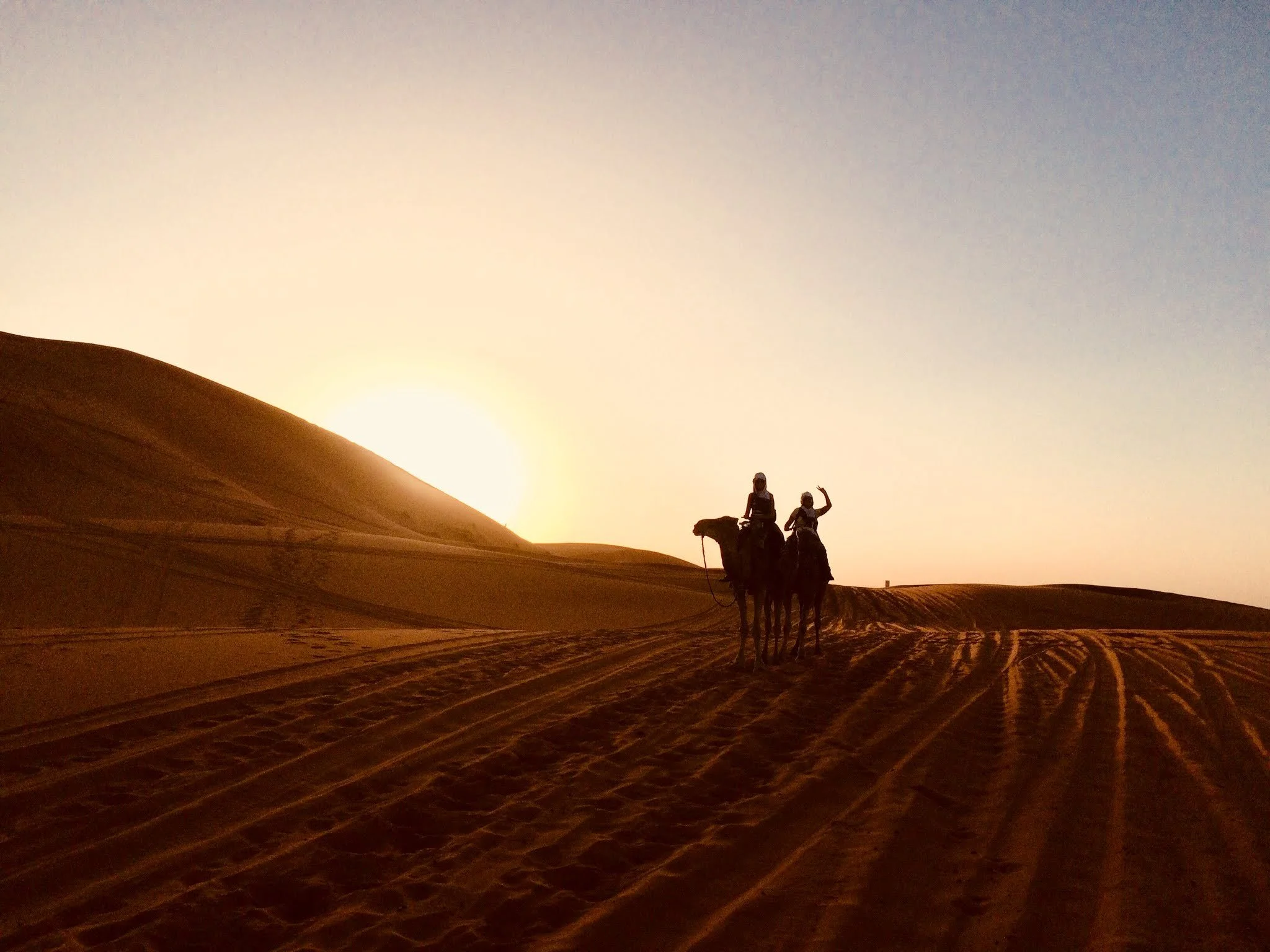
Sahara Desert
Part 3 — The Sahara
By late afternoon we reached Merzouga, a small town on the edge of the Erg Chebbi dunes — a field of orange sand dunes that rise up to 150 meters, stretching toward the Algerian border. Our guide handed us off to a Berber family who live in the area. We climbed onto camels at golden hour and rode out into the dunes. The light turned everything copper and then red and then a soft violet. When the sun dropped behind the dunes we were somewhere without roads, without signs, without any reference point except sand. We spent two nights in the desert — not in a luxury glamping camp, but in a simple Berber camp, tents with rugs on the sand floor, dinner cooked over fire, stars that blanket the whole sky in a way you simply don't see in any place with electricity. Our hosts played music on drums and a three-stringed gimbri late into the night. One of them made us mint tea with the ceremony that mint tea deserves in a Berber tent — poured from high up so the foam builds, served in small glasses, three rounds because that's the way it's done ("the first glass is as bitter as life, the second as strong as love, the third as sweet as death," goes the saying). In the morning we rode the camels back out at dawn — the same dunes, but a different planet in the early light. Frost-cool, pink, silent. A conscious-travel note on the Sahara: the difference between a good desert experience and an extractive one is almost entirely about who you go with. Berber families in Merzouga, Erg Chigaga, and the surrounding areas run small camps that are the main economic lifeline of their communities. The big package-tour operators, by contrast, often ship tourists through without much of the money staying local. Ask your riad or a trusted guide for a Berber-owned camp. It's the same price, often the same camels, but the economics are completely different. Avoid camps that promise "luxury" amenities that don't belong in the desert — giant swimming pools, air-conditioned bubble tents, helicopter tours. They're damaging to the ecosystem and to the culture that has lived in the desert for a thousand years.
Why We Hired One Local Guide, Not a Tour
This is the biggest conscious-travel lesson we took from Morocco, and we want to spell it out.
Packaged group tours in Morocco are cheap for a reason. They run on volume, kickbacks from souvenir shops along the route, and compressed schedules that are exhausting and shallow. You see the monuments, yes — but you also see the inside of a minibus for ten hours a day, you eat where they're paid to take you, and the money mostly flows to whichever company owns the tour, often not Moroccan.
Hiring one local guide, privately, costs more per person but less per experience. You get:
One Moroccan's livelihood, directly supported
A flexible itinerary (stop for the monkeys, stop for the dates, skip what doesn't matter)
The car is their car, not a fleet bus
You learn the country from the inside, not through a script
You build a real relationship — our guide is a friend we still text with
How to find one: ask your riad host. Every riad in Fes knows trustworthy guides, because they rely on repeat business. Agree on the price up front — for two people, for two days, all-inclusive of gas and the guide's food and lodging — and get it in writing if possible. Tip generously at the end if they earned it. Ours did.
A Few Practical Notes
Dress code. Morocco is a Muslim country. You don't need to cover your head as a non-Muslim woman, but shoulders and knees covered is the respectful minimum, more so in the medina and at religious sites. Men: long pants. It's also cooler than bare skin in the desert sun.
Alcohol is limited in Morocco. Riads sometimes serve wine; most restaurants in the medina don't. Respect the context.
Ramadan. If you're traveling during Ramadan, eating and drinking in public during daylight hours is disrespectful. Plan accordingly. It's also a beautiful time to be in Morocco in other ways — the break-fast meals at sunset are communal and moving.
Cash. Bring dirhams. Many souk vendors don't take cards.
Photography. Always ask. Some people, particularly older women, will refuse and mean it. Respect refusals without negotiating.
One more thing on cash — from personal experience
We want to share a story, because it's the kind of thing nobody warns you about, and knowing it might save someone else the headache.
We got robbed by our maid at our riad. It happened while we were out for the day — a chunk of cash we'd left in our room went missing. Morocco is a cash-heavy country, so we were carrying more dirhams and euros than we normally would at home. To the riad's credit, once we reported it, the owners took it seriously, investigated, caught her, and returned every dirham. It ended as well as that kind of story can end. But it was a stressful couple of days, and it taught us a lesson we now apply everywhere we travel.
Never leave cash or valuables unsecured in a hotel room — including a nice riad — when you go downstairs for breakfast or out for the day. Use the in-room safe if there is one. If there isn't, ask the reception to store your valuables in the office safe (most riads and small hotels have one and will happily do this). Split your cash into two or three stashes, kept in different places. Carry only what you need for the day, and keep a small emergency reserve somewhere separate.
This isn't a Morocco thing specifically — it's a general travel thing, and it can happen anywhere in the world, in any country, at any price point of accommodation. We don't think less of Morocco for it. The riad handled it beautifully. But "it won't happen to us because the place is beautiful and the people are warm" is exactly the assumption that got us caught out. Don't make it.
Morocco is one of the most layered countries we've ever been to — medieval city, mountain cedar forest, desert, all within a day's drive. You can see it fast on a packaged tour, or you can see it slowly with one person whose country it is. The slow way costs a little more and means a lot more. For us, it was the whole point of the trip.
And the memory we come back to isn't a monument — it's our guide, standing under a date palm on an empty road south of Midelt, reaching up with his whole arm, pulling down a handful of warm fresh dates, and handing them to us through the car window.
Travel further. Eat like a local. Leave the lightest imprint you can.
