
Bolgheri: A Day in the Home of the Super Tuscan
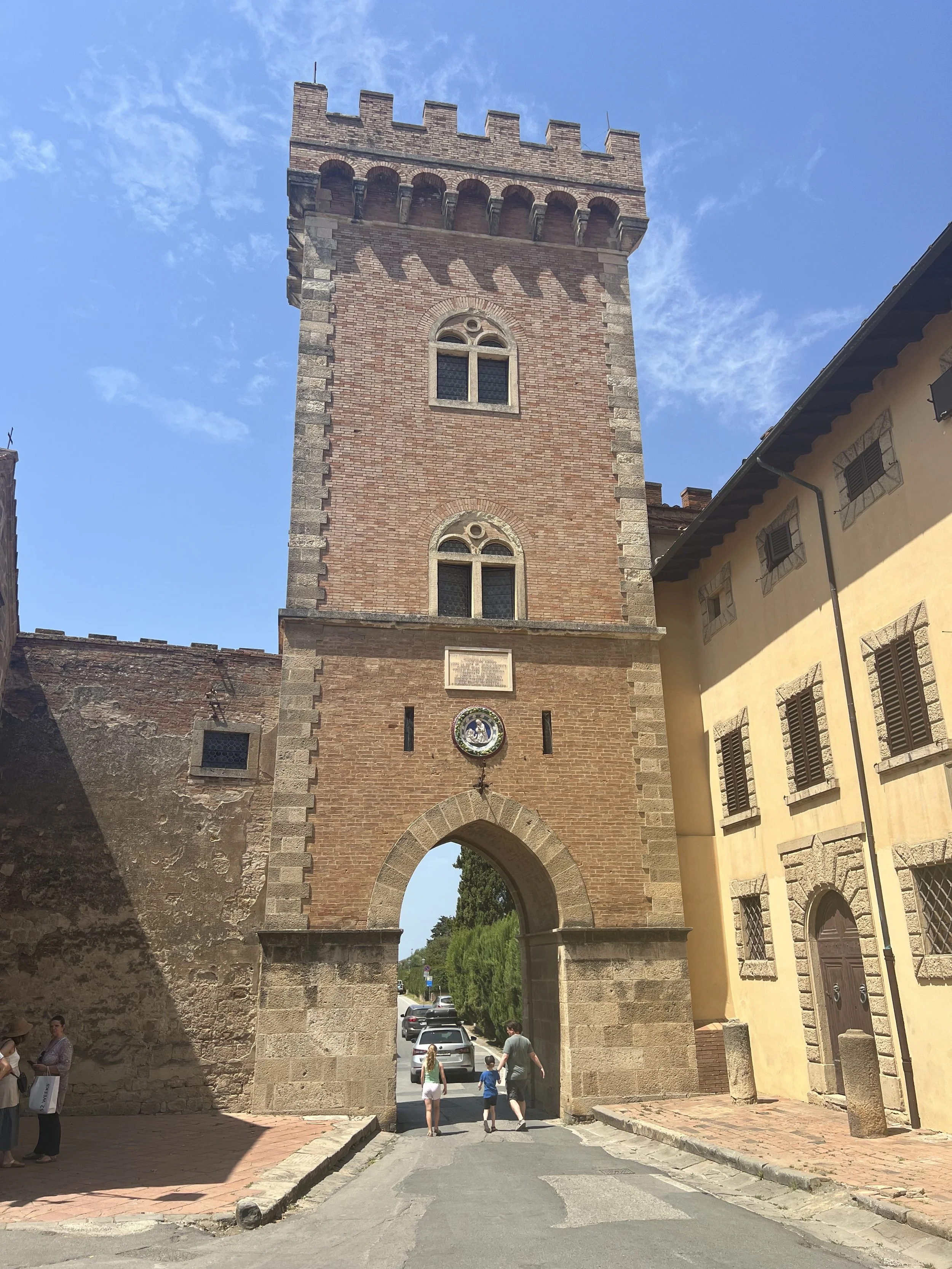
Bolgheri town entrance
If you know wine, you know Bolgheri. If you don't know wine yet, here's what you need to know: this small medieval village and the coastal hills around it, in a quiet corner of western Tuscany, are where one of the most consequential experiments in modern Italian winemaking happened — and the wine it produced, Sassicaia, rewrote what Italian wine could be.
We went to Bolgheri on a warm summer day — driving down from Lucca (where one of us is from), about ninety minutes south along the Tyrrhenian coast. We walked the village, drove the famous cypress-lined avenue, drank Sassicaia at the only place outside the family where you reliably can, and did a proper cellar tasting at a small family winery whose land used to belong to the marquis who started it all. If you love wine, this is one of the best single days you can spend in Italy.
A Short History, Because It's Worth Knowing
In the 1940s, Marchese Mario Incisa della Rocchetta — an Italian nobleman with a passion for racehorses and a deep admiration for Bordeaux — settled on his wife's family estate in Bolgheri. He noticed something other people had missed: the gravelly, stony soils of the Tuscan coast reminded him of Graves, the famous Bordeaux terroir. He had a radical idea.
He planted Cabernet Sauvignon — a grape that was virtually unheard of in Tuscany, where Sangiovese was the unchallenged king. He aged the wine in French oak barriques instead of the big neutral Italian casks. He kept it private, for the family and close friends, from the 1940s through the 1960s. In 1968, encouraged by his cousin Piero Antinori, he released the first commercial vintage. It was called Sassicaia — from sasso, the Italian word for stone, a reference to the rocky soil.
The Italian wine authorities didn't know what to do with it. A Cabernet blend from Tuscany, aged like a Bordeaux? It didn't fit any of the traditional DOC categories. So they classified Sassicaia as a humble vino da tavola — table wine — the lowest rung on the Italian wine ladder.
Then in 1978, at a blind tasting in London organised by Decanter, Sassicaia 1972 beat some of the finest wines from Bordeaux. The world noticed. An entire new category of Italian wine — what the wine world now calls the Super Tuscans — was born in this one small village. In 1994, the Italian government created a DOC appellation specifically for the wines of Bolgheri, and in 2013, Sassicaia received the extraordinary honor of its own single-estate DOC — Bolgheri Sassicaia DOC — the only wine in Italy produced by a single estate to have its own appellation.
All of this happened here. Twenty-seven hundred hectares, a few hundred people, one avenue of cypress trees, and an experiment that changed Italian wine forever.
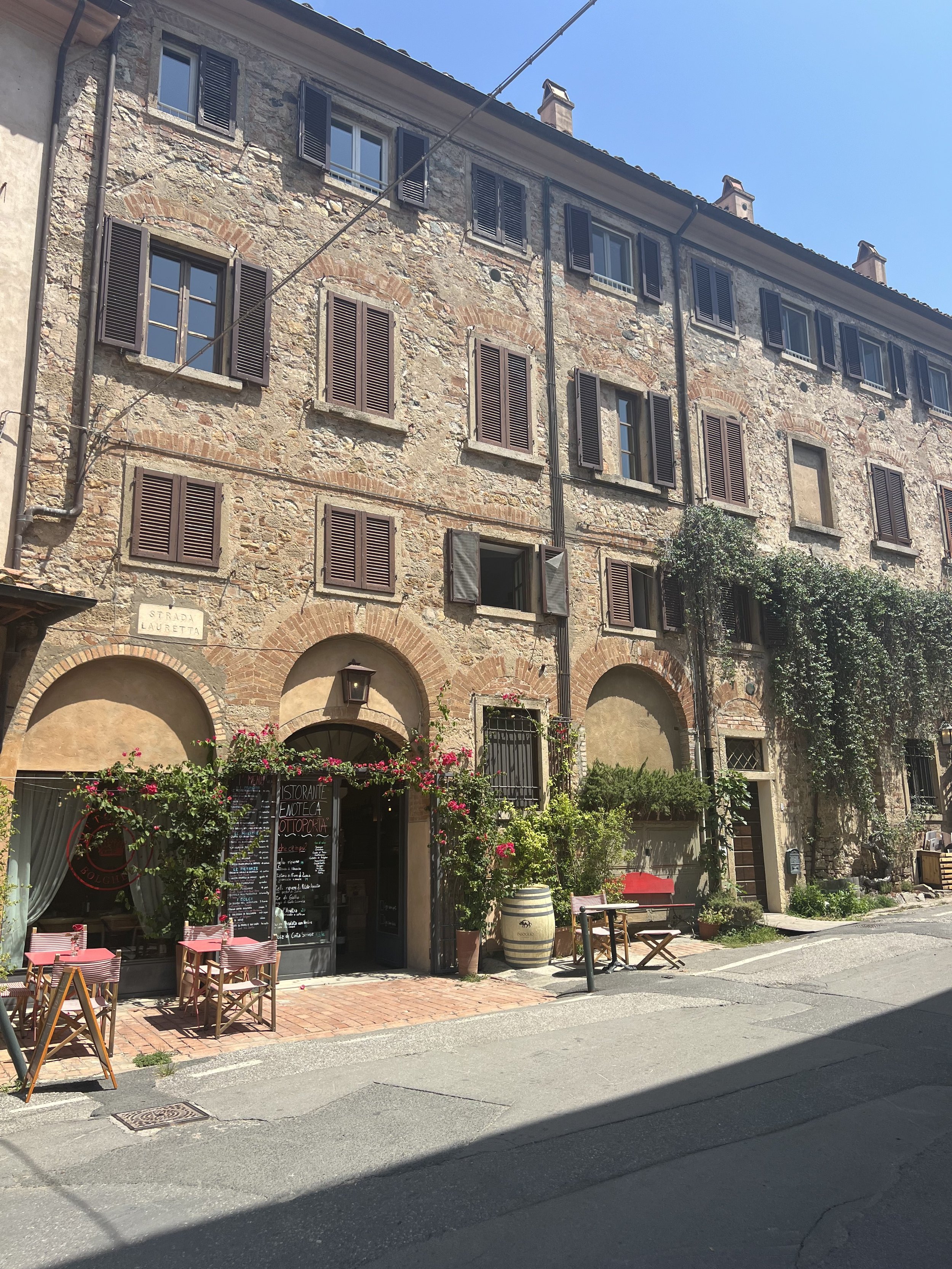
Bolgheri center
The Village
Bolgheri itself is tiny — one brick-and-stone street, a handful of wine bars, a handful of restaurants, and the castle gate at the top of the hill that marks the entrance to the village. You can walk the whole place in fifteen minutes. Come for lunch, stay for a long afternoon.
The Castello di Bolgheri — the red-brick medieval gate tower — is the anchor of the village. It's also the starting point of one of the most photographed roads in Italy: the Viale dei Cipressi, the cypress-lined avenue that runs 5 kilometers in an almost perfectly straight line from the castle down to the Oratory of San Guido on the old coast road. The Italian poet Giosuè Carducci — who grew up in a nearby hamlet and for whom the whole municipality (Castagneto Carducci) is now named — immortalized these cypresses in his poem Davanti San Guido. Drive it at least once, slowly, windows down. On either side are the vineyards of some of the most valuable wine estates in the world.
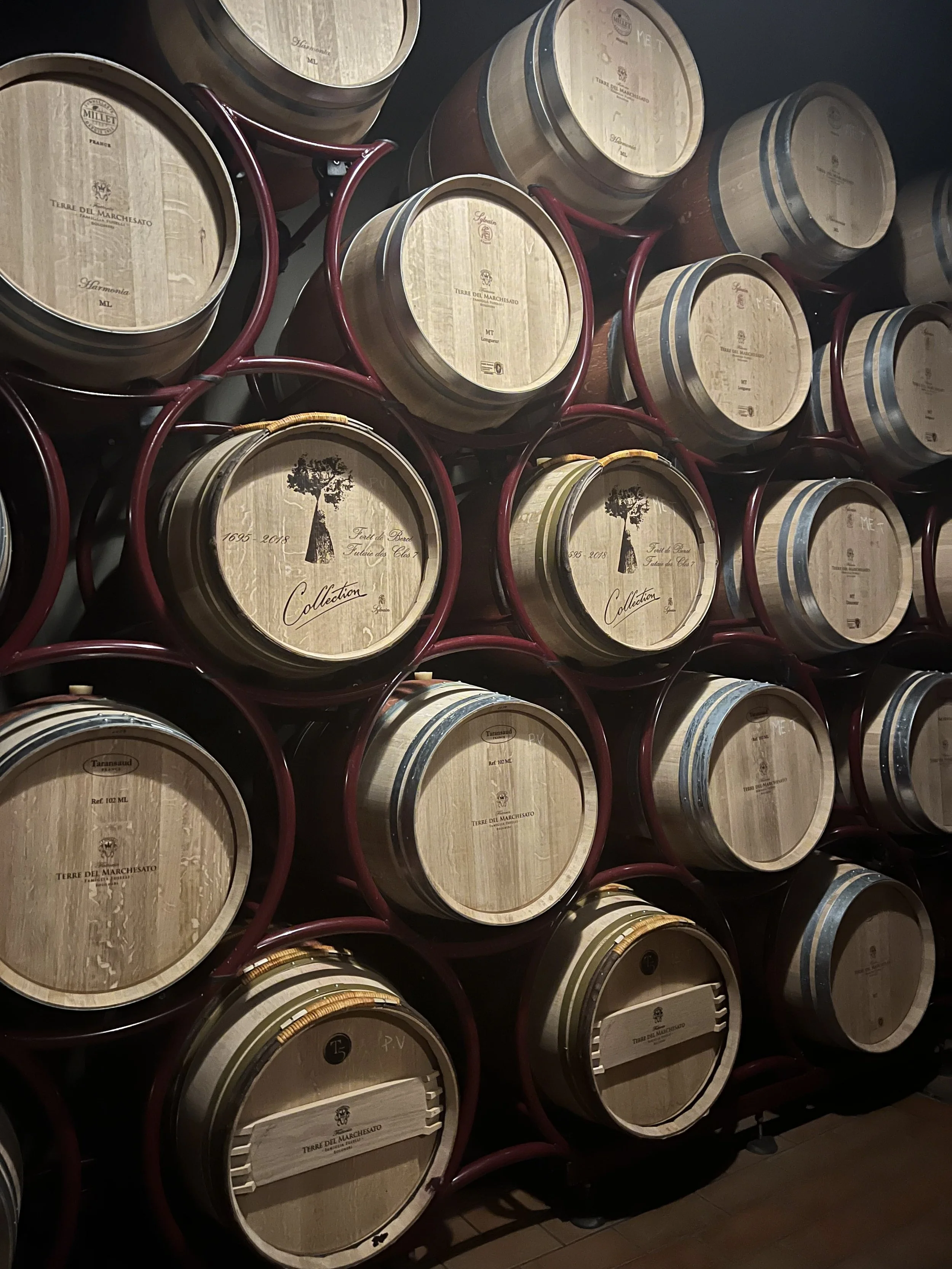
Terre del Marchesato wine cellar
The Wines — What to Know Before You Drink
Bolgheri wines are Italian but not traditional. The DOC regulations require a blend dominated by Bordeaux varieties: Cabernet Sauvignon, Cabernet Franc, Merlot, Petit Verdot, sometimes with a supporting role for Sangiovese or Syrah. The white wines are typically Vermentino, which thrives in the coastal breezes. The style sits closer to the Left Bank of Bordeaux than to anything in Chianti — structured, long-aging, mineral, with a warmth from the Tuscan sun and a saline note from the sea breeze that crosses the vineyards every afternoon.
The names to know:
Sassicaia (Tenuta San Guido) — the original, and still the benchmark. 85% Cabernet Sauvignon, 15% Cabernet Franc.
Ornellaia — the other great Super Tuscan, from the estate next door. A different blend, every bit as serious.
Guado al Tasso — the Antinori family's Bolgheri estate.
And many smaller family producers working in the same terroir — including the one we visited in the afternoon.
Lunch and Sassicaia at Osteria Enoteca San Guido
Because here's the catch that trips up almost every wine lover who makes the pilgrimage to Bolgheri: Tenuta San Guido is not open to the public. No winery tours. No tastings at the cellar. No direct sales. If you show up at the gate hoping for a visit, you'll be politely turned away. This has been their policy for decades, and they're not changing it.
But there is one place, and only one place, where you can reliably drink Sassicaia in the heart of Bolgheri at the estate's own hand: Osteria Enoteca San Guido, the restaurant that belongs to Tenuta San Guido itself. It sits right at the foot of the Viale dei Cipressi, at the Oratory end — the bottom of the avenue as you look down from the castle. This is where we had lunch.
The wine list is, as you'd expect, a greatest-hits of Bolgheri and beyond, with multiple Sassicaia vintages available by the glass (which is the only sane way to approach it — a bottle of recent-release Sassicaia runs well into the hundreds of euros). A glass is not cheap either, but it's the kind of wine that rearranges your understanding of what Cabernet Sauvignon can be. The tannins are fine-grained, the fruit is restrained, and there's a salt-and-gravel backbone underneath everything that makes it unmistakably of this coast. You drink it slowly. You think about what you're drinking.
The food is proper Tuscan cooking — wild boar ragù, handmade pasta, the excellent local olive oil, grilled steak. It's not a performance restaurant; it's the estate's kitchen, and it treats its wines as dinner rather than as ceremony.
Terre del Marchesato — The Family Winery Next Door
In the afternoon we drove a few minutes out of the village for a proper cellar tour and tasting at Terre del Marchesato, a small family-run winery that sits on some of the most valuable vineyard land in Italy — land that has a story worth telling.
In 1954, a farmer from the Marche region named Emilio Fuselli moved to Bolgheri with a group of fellow colonists. Together they bought 110 hectares of farmland — and they bought it from the Marchese Mario Incisa della Rocchetta himself, the same man who was, at that exact moment, quietly planting his experimental Cabernet Sauvignon vines a short distance away. The Fuselli family farmed vegetables and grain on that land for decades, planted a few vines for the household, and watched the Sassicaia story unfold in their backyard.
In 1998, Emilio's grandson Maurizio Fuselli — who had trained as a production manager at the Antinori family's nearby Guado al Tasso estate — decided to turn the family farm into a proper winery. He planted new vineyards, built a cellar, and started making Bolgheri DOC wines on the land his grandfather had bought from a Marchese forty-four years earlier. Today the estate is run by Maurizio, his wife Giovanna, and their three sons, Alessandro, Samuele, and Filippo. It's a real family business, on real family land, making serious wines.
We tasted through the range — a Vermentino for the white (fresh, mineral, the classic Bolgheri seaside summer wine), and then the reds. The wines we most remember are Maurizio's monovarietal series — Super Tuscan wines made from a single grape, which is much harder than blending and which most estates don't attempt. Tarabuso (100% Cabernet Sauvignon). Franchesato (100% Cabernet Franc). Aldone (100% Merlot). Maurizio Fuselli (100% Petit Verdot). Each one is the pure expression of a single grape in Bolgheri terroir, with no blending to round off its edges. They're bold, they're distinctive, and drinking them side by side is one of the best wine-education experiences we've had.
The tasting takes place in the barrel cellar — stacked French oak barriques, each stenciled with the wine it holds — and runs 75 minutes with four wines, bruschetta with the family's own olive oil, and enough time to actually sit with each wine and talk about it. Book ahead on their website; they're small and the tastings fill up. This is the real Bolgheri: a family who has been on the land since the 1950s, making the same rigorous, place-rooted wines as the famous neighbors, at a fraction of the fuss.
How to Do Bolgheri Well
Start early. Bolgheri village is small and fills up with tour buses by mid-morning in summer. Arrive before 11am or come in shoulder season (May, September, October).
Drive the Viale dei Cipressi. All five kilometers. Top down or windows open. Twice — once each direction.
Lunch at Osteria Enoteca San Guido if you want to drink Sassicaia at its home. Book well in advance in high season.
Skip the wine-bus tours. They're packaged, they visit the same three big commercial estates, and the money barely trickles down. Hire a local driver for the afternoon if you want to drink and not worry about the road — it's worth the cost, and an afternoon with a good driver who knows the estates is a small education in itself.
Visit one small family winery, not three big ones. Terre del Marchesato is one option; there are many other excellent small producers in the DOC. Book directly on the winery website, not through aggregators — the price is the same and the money goes to the family.
Buy a few bottles. Shipping wine home internationally is complicated and expensive; buying at the cellar and checking a hard-case wine suitcase on your flight home is the conscious-travel move that actually works. A bottle of small-producer Bolgheri DOC is a fraction of what it costs abroad, and the money stays with the family.
Eat wild boar. The hills around Bolgheri are full of wild boar (cinghiale) and every serious restaurant in the area does a wild boar pasta or stew. It's the local meat, it pairs perfectly with the local wines, and it's genuinely one of the best things you can eat in Italy.
Bolgheri is a short chapter of wine history compressed into a few kilometers of coastal Tuscany — a village, a castle, a 5-kilometer avenue of cypress trees, and a handful of estates whose wines are now collected and argued over all around the world. But underneath the fame there's still a real place: farming families who've been on the land for generations, olive trees, wild boar in the hills, sea breeze from the Tyrrhenian three kilometers away, and a quiet afternoon light on the stones that makes you want to stay for dinner.
Go slowly. Drink one good wine well rather than three in a hurry. And if the Fuselli family pours you a glass of their Petit Verdot in the barrel cellar on a hot afternoon, linger over it — you are drinking Bolgheri the way Bolgheri is meant to be drunk.
Travel further. Eat like a local. Leave the lightest imprint you can.
